

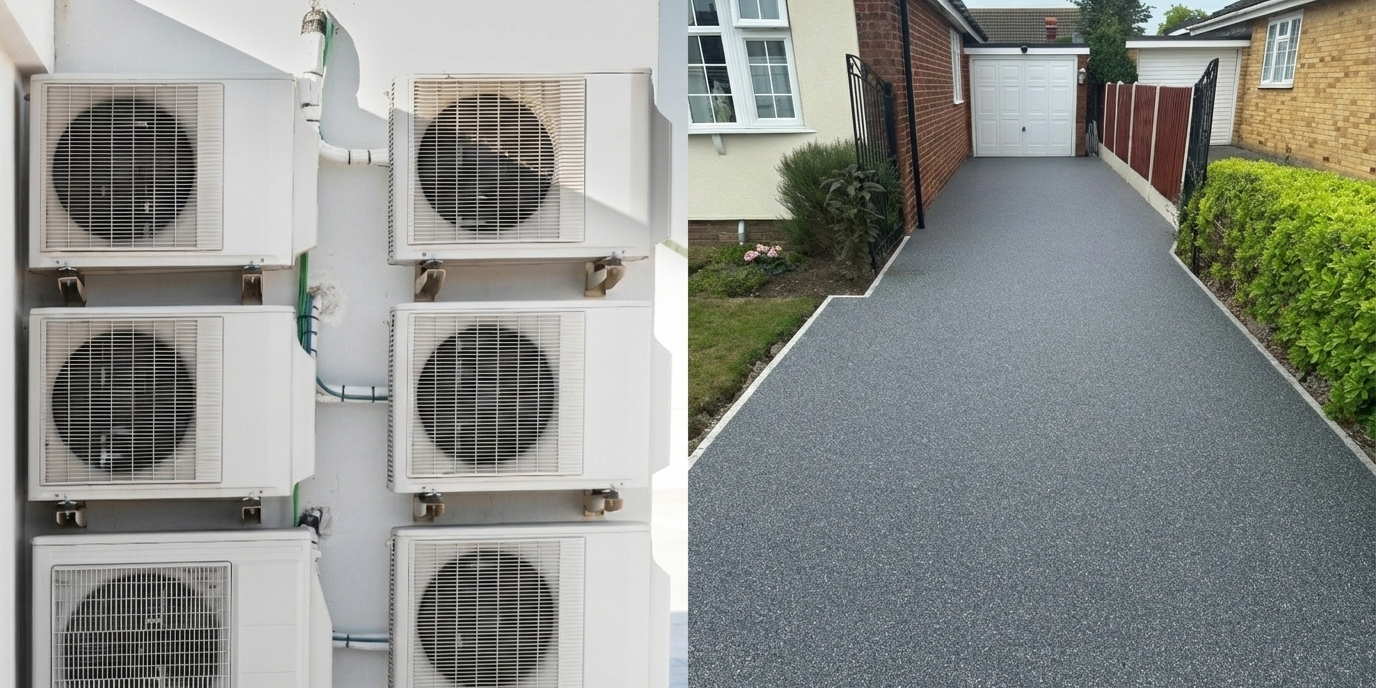
Choosing a heat pump can feel more complicated than it should. Most homeowners and developers are told they have two options: Air Source Heat Pumps (ASHP) or Ground Source Heat Pumps (GSHP).
On paper, both look like sensible low-carbon solutions. In reality, each comes with trade-offs that are often discovered too late in the process.
This guide explains how air source and ground source heat pumps *really* compare, where each system works best, and why a growing number of projects are now choosing a third approach altogether.
Air Source Heat Pumps: Simple to Install, With Practical Limitations
Air source heat pumps extract heat from the outside air and upgrade it to provide space heating and hot water. They are the most common heat pump in the UK, largely because installation is relatively straightforward and upfront costs are lower than ground source systems.
However, there are some well-known limitations.
Air source heat pumps rely on a fan and an external unit. This introduces two issues that frequently cause problems in real projects:
- Efficiency drops during cold weather. When outdoor air temperatures fall, the system has to work harder to extract usable heat. This increases electricity consumption at the very time heating demand is highest.
- Noise and visual impact. The outdoor unit is visible and produces a low hum. In dense residential areas, conservation areas, and listed buildings, this can trigger planning objections or neighbour complaints. Even when classed as "Permitted Development", visual impact remains a common reason for refusal.
Verdict: Air source heat pumps work well for modern homes with space for an external unit, tolerant neighbours, and low-temperature heat emitters. They are not always a comfortable fit for sensitive or high-value properties.
Ground Source Heat Pumps: Highly Efficient, Highly Disruptive
Ground source heat pumps extract heat from the ground, either via deep vertical boreholes or horizontal ground loops. Because ground temperatures remain relatively stable year-round, these systems deliver excellent efficiency and consistent performance.
The challenge is installation.
- Borehole drilling is expensive and disruptive. Access for drilling rigs is often limited, especially in urban locations. In rural or heritage settings, drilling can raise concerns around archaeology, tree roots, and historic landscaping.
- Horizontal ground loops reduce drilling depth but require large areas of open ground (often 3x the floor area of the property). This is rarely practical for properties without significant land.
Verdict: In many projects, ground source heat pumps look ideal on paper but stall at the feasibility or planning stage once ground disturbance is fully considered.
A Third Approach: Surface-Based Geothermal (Teratherm Surface)
There is another way to access the thermal stability of the ground without drilling boreholes or installing external units.
Teratherm Surface (a form of surface-based geothermal) collects heat from shallow hardstanding areas such as driveways, patios, courtyards, and access roads. Rather than extracting heat from deep underground, it uses the thermal mass of surfaces that naturally recharge through solar gain and ambient warmth.
The result is ground-source style efficiency without the disruption. Because the Teratherm collector is integrated beneath existing surfaces, the system:
- Has no visible outdoor unit
- Produces no external noise
- Requires no boreholes
- Involves minimal ground disturbance
This approach is particularly well suited to listed buildings, conservation areas, urban sites, and premium residential or commercial properties where appearance and planning risk matter as much as performance.
Comparison: Air Source vs. Ground Source vs. Teratherm Surface
Seasonal Efficiency
- Air Source: Variable (Drops in winter)
- Ground Source: High (Stable)
- Teratherm Surface: High (Stable)
External Noise
- Air Source: Yes (Fan hum)
- Ground Source: No
- Teratherm Surface: No (Silent)
Visible Outdoor Unit
- Air Source: Yes
- Ground Source: No
- Teratherm Surface: No (Invisible)
Boreholes Required
- Air Source: No
- Ground Source: Yes
- Teratherm Surface: No
Installation Disruption
- Air Source: Low to Moderate
- Ground Source: High (Drilling/Trenching)
- Teratherm Surface: Low (Shallow Infrastructure)
Planning Sensitivity
- Air Source: Medium to High
- Ground Source: Medium
- Teratherm Surface: Low
Listed Building Suitability
- Air Source: Often Limited
- Ground Source: Often Restricted
- Teratherm Surface: Strong
Which Heat Pump Is Right for You?
- Air Source Heat Pumps are best suited to modern homes with sufficient outdoor space, where noise is not a concern.
- Ground Source Heat Pumps work well where extensive land is available, drilling is feasible, and major ground disturbance is acceptable.
- Surface-Based Geothermal Systems are particularly effective for properties where planning sensitivity, aesthetics, noise, or reversibility are key concerns. This includes listed buildings, conservation areas, urban sites, hospitality projects, and high-value residential homes.